
















Pros and Cons of Different Types of Gel Nail Polish in 2026

In brief
Navigating the world of DIY gel nails can be confusing, especially with terms like "gel nail polish" being used incorrectly. This authoritative guide breaks down the 6 primary UV-curing gel products—from Gel Polish to Polygel—explaining their pros, cons, and which nail type they suit best. Furthermore, we highlight why ingredient safety is paramount, ensuring you know why all products from The Gel Collection are strictly 100% HEMA-free, di-HEMA-free, TPO-free, and 21-free.
If you have been searching for the best "gel nail polish" to start your DIY manicure journey, you are not alone. It is one of the most commonly searched terms when people want beautiful, long-lasting nails at home. However, to achieve salon-quality results, we first need to clear up a widespread misunderstanding: the correct professional terminology is gel polish or UV-curing gel products. They are fundamentally different from traditional nail polish.
As the DIY nail community grows in 2026, understanding exactly what you are putting on your nail plate is more important than ever. This comprehensive guide serves as your ultimate, authoritative source for comparing gel products. The theory, terminology, and anatomical facts presented here are strictly based on the authoritative book Negle by Signe Hartung Roslyng (Gyldendal, 2024).
What is the Difference Between Classic Nail Polish and UV-Curing Gel Products?
The distinction between classic nail polish and gel products comes down to chemistry and how the product transitions from a liquid to a solid state.
Classic nail polish relies on evaporation. It contains solvents that evaporate into the air, leaving the color pigments behind as a hard film. This process is called drying, and it can take hours for the polish to fully set, often resulting in smudges. Furthermore, classic polish offers no structural reinforcement to the natural nail and typically chips within a few days.
Gel products, on the other hand, do not dry; they cure. They contain specific molecules called photoinitiators. When exposed to the specific wavelengths of a UV/LED lamp, these photoinitiators trigger a chemical reaction that links the molecules together into a solid, durable polymer network. This provides a flawless, high-gloss finish that lasts for weeks and, depending on the product, can offer significant structural reinforcement.
Did you know?
A slight warming sensation during the curing process is completely normal. This is caused by the photoinitiators reacting to the UV light and creating friction as the liquid gel transforms into a solid state. Using a "Low Heat Mode" on your lamp gradually increases the UV light, making the curing process much gentler on the nail bed.
Comparison: The 6 Types of Gel Products (Pros and Cons)
To help you navigate the options, we have categorized the six primary UV-curing gel products available for DIY use. Each has a specific purpose, consistency, and ideal user profile.
1. Gel Polish (Also known as Shellac or Gellak)
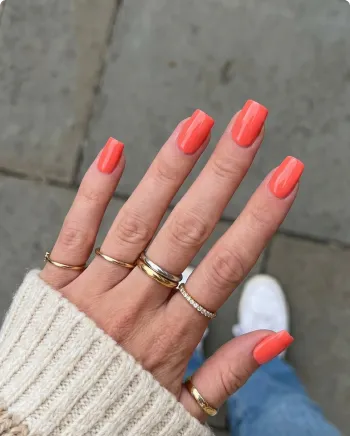
Gel polish is a hybrid between classic nail polish and gel. It is the product most beginners start with because it applies easily with an integrated brush, much like traditional polish.
- Pros: Very easy to apply due to its thin, fluid consistency. It provides a stunning, high-gloss color that lasts up to 3 weeks without chipping.
- Cons: It does not provide any structural reinforcement to the nail.
- Best for: People with naturally strong, hard nails, or to be used as a color layer on top of a reinforcing product like rubber base or builder gel.

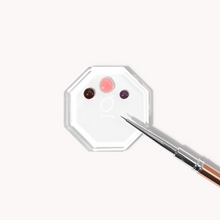
Pro tip: If you love creating nail art with your gel polish, combining it with tools like the Blooming Gel Kit allows you to create effortless marble and floral designs.
2. Rubber Base
Rubber base is a true game-changer in the DIY nail world. It is a flexible gel designed specifically to reinforce the natural nail.
- Pros: It combines strength with flexibility. Because it is rubberized, it bends and moves with your natural nail, absorbing shocks that would otherwise cause the product to lift or the nail to break. It boasts an impressive durability of 4-6 weeks.
- Cons: Because of its flexibility, it cannot be used to build long extensions.
- Best for: Thin, brittle, or damaged nails that need extra support without feeling rigid.
3. Builder Gel
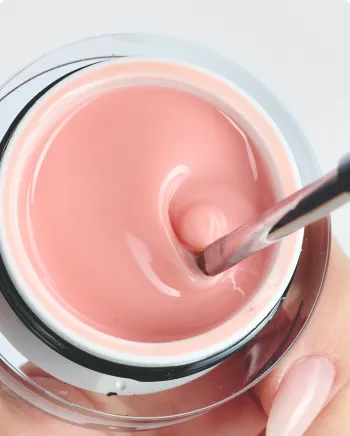
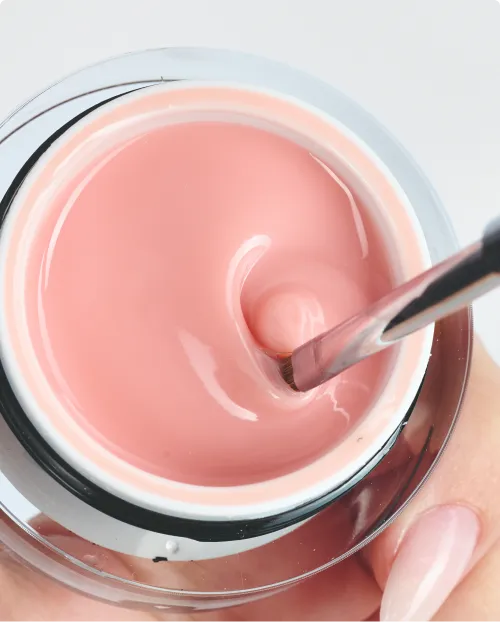
Builder gel is a hard gel that comes in an open pot and is applied using a separate brush, such as those found in a Premium Brush Set.
- Pros: It provides ultimate strength and structure. It is the go-to product for creating extensions from scratch using classic tips, paper forms, or dual forms. There is no limit to the length you can achieve. Durability is fantastic, lasting 4-8 weeks with proper infills.
- Cons: It requires a bit more practice to master the application and build the correct apex (the highest point of the nail for structural integrity).
- Best for: Soft, flexible nails that need a rigid structure to prevent bending, and for anyone wanting long extensions.

4. Polygel (Hybrid Gel / Acrylic Gel)
Polygel is a fascinating hybrid between hard gel and acrylics, but it requires UV curing. It has a very thick consistency, much like soft modeling clay.
- Pros: It does not flow or self-level on its own. You shape it using dabbing motions with a brush lightly dampened in a slip solution. This gives you 100% control over the product, making it excellent for beginners doing extensions.
- Cons: Due to its thickness, it can be challenging to apply thinly enough on very short natural nails.
- Best for: Building extensions from scratch on nails that already have a bit of free edge.


5. Liquid Builder Gel (BIAB)
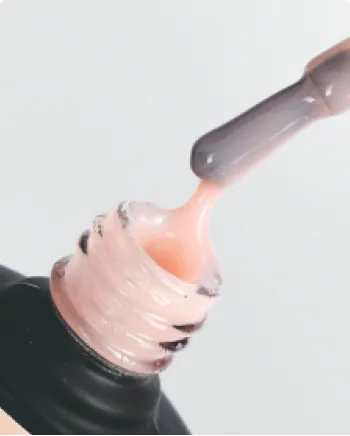
Liquid Builder Gel, often referred to in the industry as BIAB (Builder In A Bottle), brings the strength of a hard gel into a convenient bottle format.
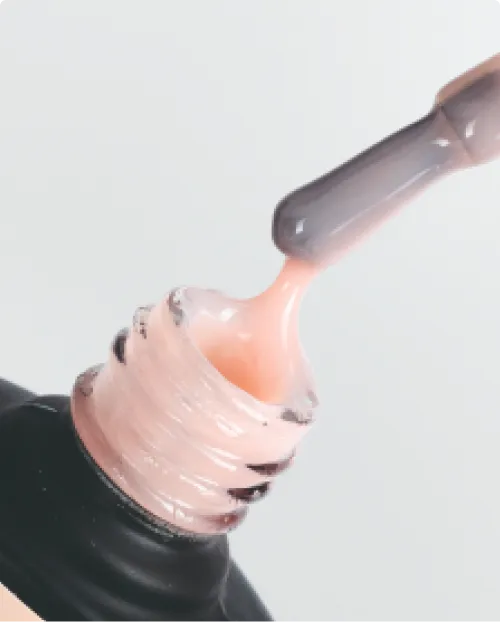
- Pros: It applies easily with an integrated brush, just like gel polish. It is incredibly strong, making it ideal for repairing broken nails or creating short extensions.
- Cons: Because it is self-leveling and thinner than traditional potted builder gel, it requires you to work relatively quickly to prevent it from flooding the cuticle area (eponychium).
- Best for: Thin or fragile nails that need hard reinforcement, and for quick repairs.

6. Gel Tips (Soft Gel Press-On Tips)
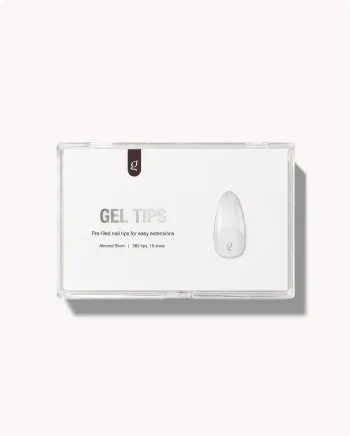
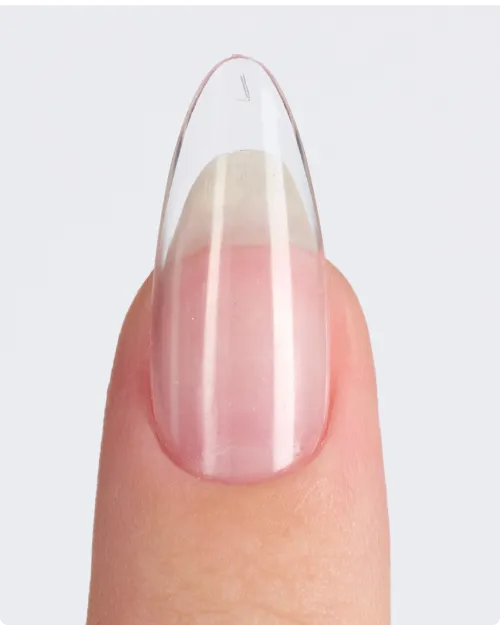
Gel tips have revolutionized nail extensions. Unlike traditional plastic press-ons applied with standard nail glue (cyanoacrylate), these are full-cover tips pre-molded from gel.
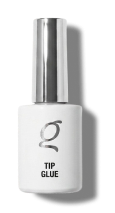
- Pros: They are attached using a UV-curing gel glue, creating a seamless, highly durable bond that lasts 3-5 weeks. They are much gentler on the natural nail and provide instant, uniform length and shape.
- Cons: They require a specific application technique, often necessitating a mini UV lamp to "flash cure" the tip in place while you hold it.
- Best for: Anyone wanting instant, perfect extensions without the learning curve of building them manually. Excellent for nail biters.
Important: When applying Gel Tips, you must hold the tip firmly in place while curing to avoid air bubbles. A hands-free or highly directional lamp is essential for this step.

Chemistry and Safety: Why Ingredients Matter in 2026
When working with UV-curing gel products at home, safety and chemistry must be your top priority. All UV-curing gels contain acrylates, which can be allergenic in their liquid form if they come into contact with the skin (such as the lateral folds or the living eponychium). Proper curing under a high-quality UV/LED lamp converts these liquid acrylates into a solid, safe polymer.
However, the formulation of the gel itself is critical. Certain chemicals are known to be frequent allergens. This is why ALL products from The Gel Collection are 100% HEMA-free, di-HEMA-free (di-HEMA-TMHDC), and TPO-free—and they ALWAYS have been, without exception. Furthermore, our products are strictly 21-free, meaning they are formulated without 21 specific, potentially harmful chemicals commonly found in older or cheaper cosmetics.
"Under-curing your gel products leaves unreacted acrylates on the nail, which drastically increases the risk of developing allergies and results in a soft product with poor durability. Always ensure your lamp matches your product's requirements."
— Signe Hartung Roslyng, Negle (Gyldendal, 2024)
To maintain a safe environment while filing and removing products, we highly recommend using a dust collector. Remember to regularly change your Filter for Dust Collector to ensure optimal suction and keep airborne dust particles away from your respiratory system.
How to Choose the Right Product for Your Nail Type
Selecting the right product is not just about the look; it is about analyzing your natural nail plate.
- Normal Nails: Require minimal reinforcement. A standard base coat and Gel Polish are usually sufficient.
- Thin/Brittle Nails: Need reinforcement that can absorb shock. Rubber Base is your best friend here.
- Soft/Flexible Nails: Bend too easily and need rigid structure. Builder Gel or Liquid Builder Gel provides the necessary hardness.
- Damaged Nails: Require extremely gentle prep (avoid over-filing the nail plate) and a protective layer of Rubber Base to grow out safely.
If you are setting up your DIY station or looking for a comprehensive gift, The kit for the person who has everything is an excellent starting point, providing high-quality, safe tools. Furthermore, maintaining your tools is crucial; utilizing a Micro Mandrel Bit + Micro Sanding Bands ensures precise, gentle prep work around the cuticle area without damaging the living tissue.
Frequently Asked Questions
Expert source
Signe Hartung Roslyng
Founder of TheGelCollection.com & author
Expert guidance in this article is based on knowledge from Negle (Gyldendal, 2024) by Signe Hartung Roslyng — the first Scandinavian reference book on professional gel nails.