















Does Rubber Base Gel Need a Top Coat? Complete Guide

In brief
Yes, rubber base gel absolutely requires a top coat if it is your final layer. After curing, rubber base leaves a sticky inhibition layer of uncured molecules. A top coat seals the gel, provides a scratch-resistant shield, and ensures a high-gloss finish that lasts 4-6 weeks.
The Short Answer: Yes, Here is Why
When creating DIY gel nails, understanding the exact chemistry and layering process of your products is the difference between a manicure that chips in days and one that lasts for weeks. To answer the question directly: Yes, rubber base gel requires a top coat to function correctly as a finished nail enhancement.
According to the principles of gel chemistry, UV-curing gel products consist of monomers, oligomers, and photoinitiators. When exposed to specific UV light wavelengths (365 and 405 nm), these molecules bind together to form a solid structure. However, the very top surface of the gel is exposed to oxygen, which prevents the uppermost molecules from fully curing. This results in the "sticky layer" (also known as the inhibition layer).
The natural nail plate consists of 25-50 layers of dead keratin cells and has a thickness of exactly 0.25-0.6 mm. While rubber base is engineered to adhere to these keratin layers and provide structural reinforcement for 4-6 weeks, it is not formulated to be an outer shield. A top coat gel is a specifically formulated, hard-wearing outer layer designed to seal the sticky layer, block out dirt, and provide a scratch-resistant, high-gloss finish.
"The sticky layer is a completely normal part of the curing process. It acts as a double-sided adhesive tape that helps the next layer of gel bond securely. However, to finish the nail, this system must be sealed with a top coat to protect the enhancement from daily wear and tear."
— Signe Hartung Roslyng, Negle (Gyldendal, 2024)
What Exactly is Rubber Base Gel?
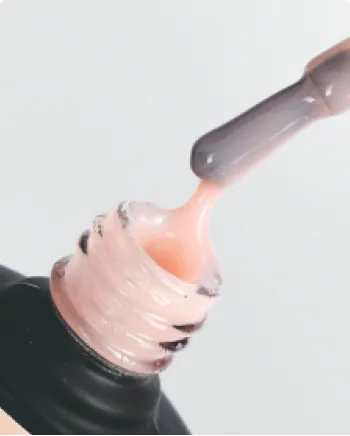
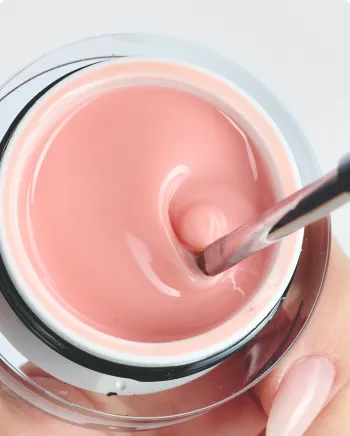
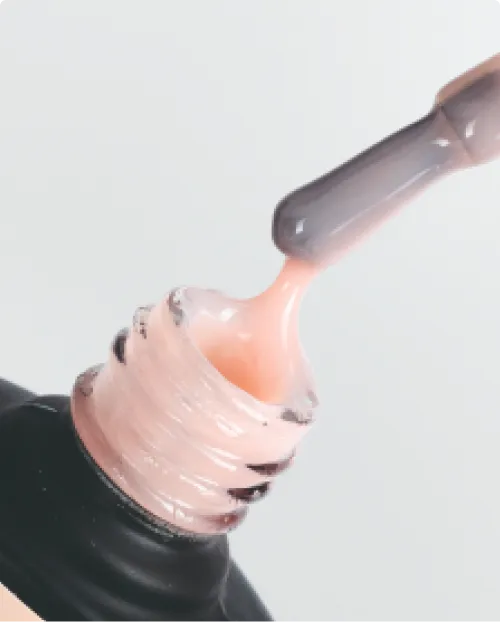
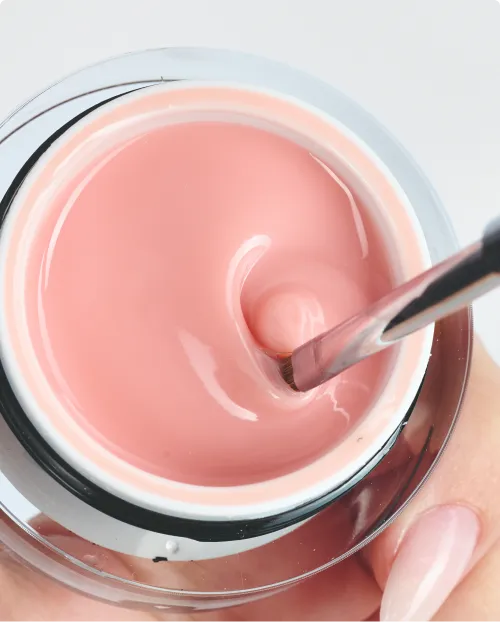
To understand why a top coat is mandatory, you must first understand the purpose of a rubber base. Rubber base is a flexible, UV-curing gel designed specifically for the reinforcement of natural nails. It combines strength with high flexibility, allowing the gel to adapt to the natural movements of the nail plate without cracking or breaking.
This makes it the ideal product for thin, fragile, or damaged nails. It has a thick but fluid, self-leveling consistency that allows you to build a correct apex (the highest point of the nail, placed at the stress area) to distribute weight and prevent the free edge from snapping. When applied correctly, a rubber base reinforcement offers a durability of 4-6 weeks and can be refilled rather than removed completely.
Did you know?
Rubber base is designed for short to medium-length natural nails. If you want to build long extensions using classic tips or dual forms, you must use a hard gel like builder gel or polygel, as rubber base is not structurally rigid enough to support long extensions.
Because rubber base is engineered for flexibility and adhesion rather than surface hardness, leaving it exposed without a top coat compromises the entire structure. If you are looking to maintain optimal health for your natural nail plates, sealing your reinforcement properly is non-negotiable.
The Correct Application Order for Gel Nails
Applying gel products in the wrong order is the leading cause of premature lifting and chipping. Whether you prefer a natural look or want to add a vibrant color, the structural hierarchy remains the same. Here is the definitive application order.
Scenario A: The Natural Reinforcement Look
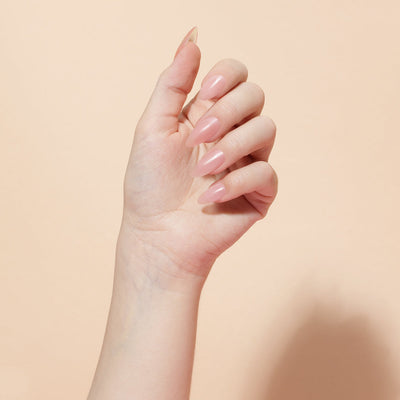
If you love the natural, slightly milky or pink tint of a tinted rubber base and do not want to apply a separate color, you still cannot skip the final step. The order is:
- Prep: Push back cuticles, gently mattify the nail plate with a 100-grit buffer, cleanse with a lint-free wipe saturated in cleaner, and apply primer. Let the primer air dry for 60 seconds.
- Rubber Base: Apply a thin slip layer, then a small bead to build the apex. Cure for 60 seconds under a 48W UV/LED lamp.
- Top Coat: Apply a thin, even layer of top coat directly over the sticky layer of the cured rubber base. Cure for 60 seconds.
Scenario B: With Gel Polish Color
If you want to add a color layer, the gel polish sits sandwiched between your structural reinforcement and your protective shield. The order is:
- Prep: Complete the standard preparation routine to ensure zero oils remain on the nail plate.
- Rubber Base: Apply and cure your rubber base to build the foundation.
- Gel Polish: Apply 2 very thin layers of gel polish. Cure each layer for 60 seconds.
- Top Coat: Apply your top coat to seal the color and provide maximum shine. Cure for 60 seconds.

Important: You must seal the free edge (the tip of the nail that extends past the finger) with every single layer of product. Brush horizontally across the tip with your rubber base, your gel polish, and your top coat. This prevents water and dirt from penetrating the layers and causing pocket lifting.
If you want to dive deeper into the exact techniques for flawless color application, you can master the exact technique for applying your gel layers in our comprehensive guide.
What Happens If You Don't Apply a Top Coat?
Skipping the top coat is a critical error in DIY gel nails. If you cure your rubber base and simply stop there, several negative consequences will immediately follow:
- The surface remains sticky: Because of oxygen exposure during curing, the top layer of the rubber base remains an uncured, sticky residue.
- Immediate contamination: This sticky layer acts like a magnet. Within minutes, your nails will be covered in lint, dust, pet hair, and dirt from your clothes.
- Allergy risks: Uncured gel molecules (monomers) are small enough to penetrate the skin. If the sticky layer constantly rubs against your skin or face, it significantly increases the risk of developing a contact allergy.
- Dull appearance: Rubber base is not formulated with high-shine properties. Without a top coat, the nail will look dull, uneven, and unfinished.
- Structural weakness: Without the hard, protective shell of a top coat, the rubber base is highly susceptible to scratches, dents, and premature lifting at the free edge.
If you are experiencing issues with your manicures not lasting the promised 4-6 weeks, you can troubleshoot premature lifting and dull finishes to identify flaws in your application routine.
Can I Wipe Off the Sticky Layer Instead of Using a Top Coat?
A common misconception among beginners is that you can simply wipe away the sticky layer of the rubber base using a lint-free wipe and cleaner, thereby avoiding the need for a top coat.
While it is chemically true that wiping the nail with cleaner will remove the uncured monomers and eliminate the stickiness, it is a terrible idea for the longevity of your manicure. As established by the terminology in the book Negle (Gyldendal, 2024), rubber base is a reinforcement product, not a finishing product.
If you wipe off the sticky layer of a rubber base, you will be left with a completely matte, slightly rubbery surface. Because it lacks the scratch-resistant properties of a top coat, this exposed surface will quickly absorb stains from makeup, spices, or dark clothing. It will also wear down rapidly at the free edge, leading to chipping within a matter of days. Always use a dedicated top coat to finish your set.
Watch our guide: Knowledge about the UV Curing Process to understand exactly how your lamp interacts with photoinitiators.
Safe DIY Gel Nails: Why Ingredients Matter
When working with UV-curing gel products at home, understanding the chemistry and safety of your products is paramount. The European Union's Cosmetics Regulation is incredibly strict, and the SCCS (Scientific Committee on Consumer Safety) requires a safety margin of at least 100x for cosmetic ingredients.
At The Gel Collection, we take your health seriously. ALL products from The Gel Collection are 100% HEMA-free, di-HEMA-free (di-HEMA-TMHDC), and TPO-free—and they always have been, without exception. Furthermore, all our products are 21-free, meaning they are formulated without 21 specific, potentially harmful chemicals often found in lower-quality brands.

HEMA (hydroxyethyl methacrylate) is a common allergen found in many professional nail products. While safe for trained professionals who avoid skin contact, it poses a significant risk for DIY users. By ensuring our entire range is free from HEMA and TPO (a photoinitiator recently scrutinized by the EU), we provide a safer environment for your home manicures. However, even with HEMA-free products, correct curing and avoiding skin contact remain essential to prevent contact allergies.
To ensure you have the right tools for a safe application, you can explore our selection of high-quality UV/LED lamps that are perfectly calibrated to cure our 21-free formulas.
Frequently Asked Questions
Expert source
Signe Hartung Roslyng
Founder of TheGelCollection.com & author
Expert guidance in this article is based on knowledge from Negle (Gyldendal, 2024) by Signe Hartung Roslyng — the first Scandinavian reference book on professional gel nails.