















Frequently Asked Questions

In short
Choosing the right UV-curing gel products depends on the condition of your natural nails and your final goal. This guide helps you navigate between gel polish, rubber base, and builder gel, and explains why proper prep and 100% HEMA-free products are crucial for safe and long-lasting DIY gel nails.
What nail products should you choose in 2026? It depends on your nail type. For strong, balanced nails, gel polish is sufficient, while thin or flexible nails require reinforcement with a rubber base, builder gel, or liquid builder gel. The most important thing is to choose EU-approved, HEMA-free products and match them with the correct UV/LED lamp to ensure a full cure.
According to the EU Cosmetics Regulation, ingredients in cosmetics are assessed with a safety margin of at least 100 times. But to ensure optimal safety for DIY use, we go a step further: ALL products from The Gel Collection and Neglefeber are 100% HEMA-free, di-HEMA-free, and TPO-free — and always have been, without exception.
In this ultimate buying guide, we equip you to make the right choices, whether you are a beginner or slightly experienced, based on the latest professional knowledge.
Start here: Know your nail type before you buy
The biggest mistake many people make is buying products without taking the condition of their natural nails into account. The wrong product on the wrong nail almost always results in *lifting* (the product lifting from the nail plate).
To achieve a durability of up to 3-4 weeks, the foundation must be right. Here are the four primary nail conditions you need to know:
* Balanced nails: These have a milky pink color, a smooth surface, and are robust. Durability issues are rarely experienced here, and you can often just do a classic gel polish treatment without extra reinforcement. * Thin and fragile nails: Nails that bend or split easily. These require a flexible reinforcement product like a *rubber base* or *liquid builder gel* that can move with the natural nail without breaking. * Dry nails: Often appear matte and are prone to breaking. They require extra care with cuticle oil (at least twice a day). Avoid excessive contact with water before application, as wet nails expand and later shrink, which causes lifting. * Oily nails: Have a natural shine and feel slightly greasy. These nails require incredibly thorough degreasing (prep) with a cleaner and primer. It is recommended to work with 1-2 fingers at a time and cure the base coat quickly (flash cure).
"The nail plate consists of 25-50 layers of dead keratin cells and does not need oxygen. Therefore, it does not damage the nail to wear gel products for a long time, as long as the prep and removal are performed correctly."
— Signe Hartung Roslyng, Negle (Gyldendal, 2024)
The 6 primary UV-curing gel products (Your checklist)
When navigating nail products, it is essential to know the difference between the various types of UV-curing gel. We do not sell classic nail polish that air-dries and chips after a few days. We work exclusively with professional gel products for home use.
Here are the 6 product types defined so you can make the right choice:
1. Gel Polish
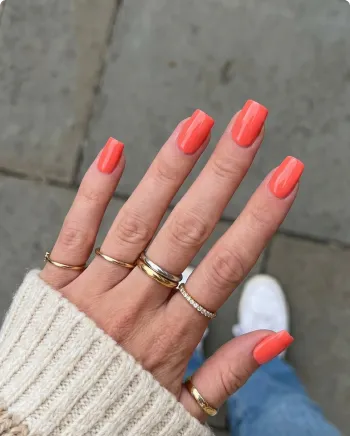
Gel polish (often called gel lacquer or shellac) is a hybrid between classic nail polish and gel. It provides intense color and a durable shine for up to 3 weeks. Gel polish provides *no* reinforcement on its own and is best for naturally strong nails. The consistency is thin and fluid, and the product must be applied in very thin layers. If the layer is too thick, it will wrinkle in the UV lamp because the UV light cannot penetrate and cure the bottom.
2. Rubber Base
A flexible gel designed for reinforcing natural nails. Rubber base combines strength with extreme flexibility, meaning it adapts to the nail's natural movements without breaking. It is ideal for thin, fragile, or damaged nails and has a durability of 4-6 weeks. Unlike gel polish, rubber base can be infilled, so you don't have to remove all the product every time.
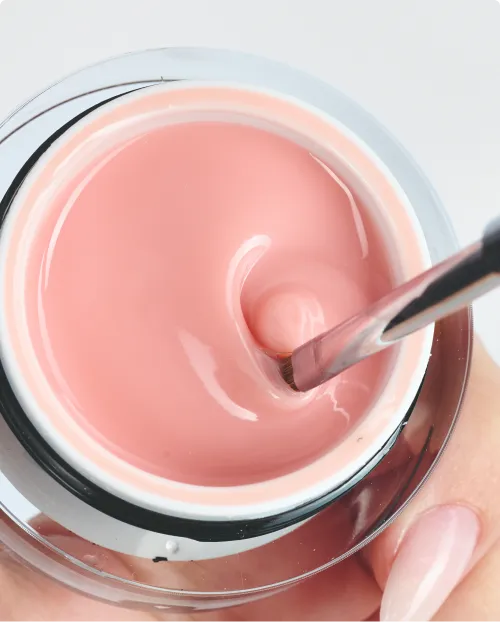
3. Builder Gel
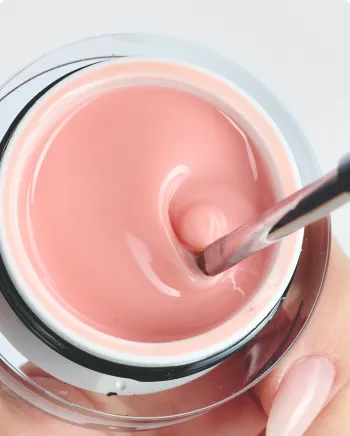
This is a hard gel used for both reinforcement and extensions from scratch. It is typically found in an open pot and applied with a separate brush. Builder gel is self-leveling, meaning it smooths itself out on the nail, but it takes a little practice to control it before it flows out of shape. It is fantastic for building a strong *apex* (the highest point of the nail, which distributes weight and prevents breaking).4. Polygel (Hybrid Gel)
Polygel is a hard gel for extensions that has a thick consistency like soft modeling clay. It does *not* flow on its own, giving you full control and plenty of time to shape the nail before it is cured in the lamp. It is distributed with dabbing motions using a brush moistened with cleaner (to prevent the gel from sticking to the brush). Polygel is often the absolute best choice if you want to build nails using *dual forms*.
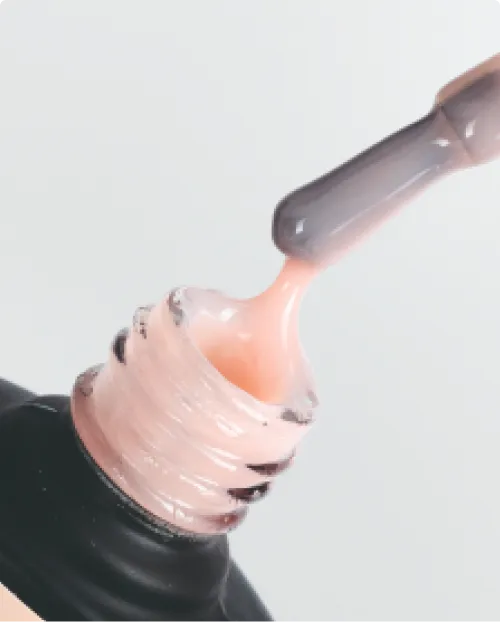
5. Liquid Builder Gel (BIAB)
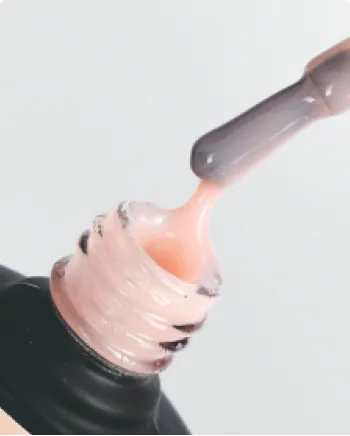
Liquid builder gel, also known in the industry as BIAB (Builder In A Bottle), is a hard gel in a bottle with an integrated brush. It is ideal for reinforcement, repairing broken nails, and very short extensions. The difference between this and a rubber base is that liquid builder gel cures harder, making it capable of repairing small damages on the free edge.6. Gel Tips (Soft Gel Press-on)
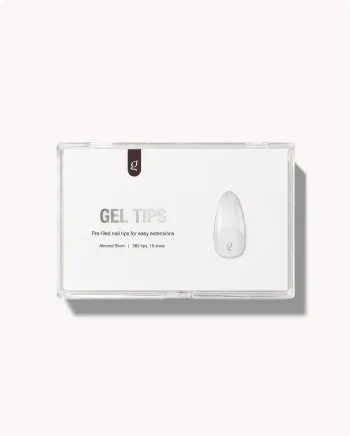
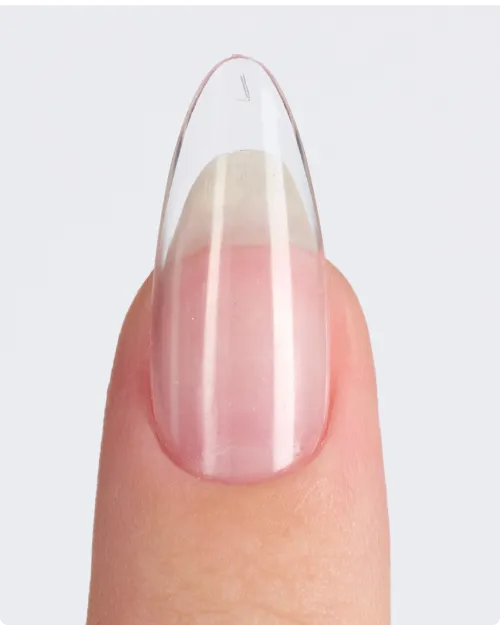
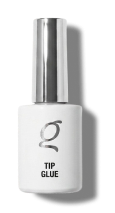
Gel tips are full-cover tips that are pre-molded in gel. They are attached to the natural nail with a UV-curing gel glue (never superglue!). This is an incredibly popular and gentle method for getting long, perfect nails quickly. It is recommended to use a mini UV lamp to "flash cure" the tip for 30 seconds while holding it in place.Did you know?
Gel products do not air-dry — they cure. Liquid gel consists of monomers and oligomers. When exposed to UV light, the photoinitiators in the gel are activated, causing the molecules to bind together in a solid grid. This is called polymerization.
Chemistry and Safety: Why you should choose HEMA-free products
When doing DIY gel nails, you are working with acrylates. In their liquid, uncured form, acrylates are potentially allergenic if they repeatedly come into contact with the skin. However, once the product is 100% fully cured in the lamp, the molecules have become too large to penetrate the skin, and the product is safe.
To significantly minimize the risk of contact allergy, it is crucial to look at the ingredient list. The EU clearly distinguishes between products for professional use and home use. Professional products are allowed to contain substances like HEMA (hydroxyethyl methacrylate) and di-HEMA, but these are illegal to sell for home use in the EU.
Important: ALL products from The Gel Collection and Neglefeber are 100% HEMA-free, di-HEMA-free, and TPO-free — and ALWAYS have been. Furthermore, they are 21-free, meaning they are free from 21 specific, potentially harmful chemicals.
Never buy nail products from Asian platforms, as these often lack the mandatory European cosmetic product safety report (CPSR). A safety data sheet (SDS) is not the same as a product safety assessment; SDS is exclusively for occupational health and safety use.
Prep and Curing: The indispensable accessories
Even the best and most expensive gel product will lift if the preparation (prep) of the natural nail is not performed correctly. Prep is the foundation for all durability.
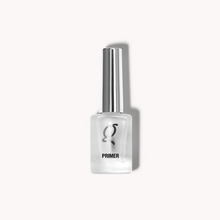
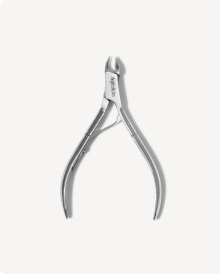
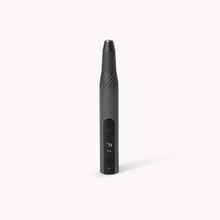
Proper prep involves: 1. Cuticle removal: Both the visible and the invisible cuticle (the thin membrane of dead cells on the nail plate) must be removed. Push gently with a cuticle pusher. 2. Matting the nail plate: Use a 100-grit buffer to create a microscopic surface grid for the gel to grip onto. You must *never* file layers off the natural nail with a coarse file — light matting is enough. Overfiling leads to thin, soft nails and poor durability. 3. Cleansing and dehydrating: Use a lint-free wipe saturated with cleaner to remove all filing dust and natural oils. 4. Primer: Apply a thin layer of primer that air-dries for 60 seconds.To make prep work and especially removal/infilling easier and more gentle, an electric nail file is a fantastic investment.


Infilling rather than removal
An important rule of thumb in 2026 is to prefer *infilling* over full removal. As the nail grows out, you simply file off 50-80% of the old product, remove any lifting, prep the new growth of the natural nail, and fill in with new product. This is incredibly gentle on the natural nail, as you avoid drying it out with acetone or risking overfiling during full removal. Gel products do not make nails thin — incorrect removal does.A beloved child has many names: From "gel nail polish" to Gel Polish
Are you searching for *gel nail polish* or *long-lasting nail polish*? In Denmark and in the professional industry, we correctly call it gel polish. Many also know it under trademarks like shellac or the popular term gel lacquer.
What they all have in common is that they are *not* classic nail polish. Classic nail polish air-dries as solvents evaporate. Gel polish contains photoinitiators and must be cured in a UV/LED lamp. It is precisely this chemical process that provides the unsurpassed durability, the intense shine, and the ability to reinforce the nail with products like rubber base under the color.